 amberline
Gas Safe, Part P, and 18th Edition: A Trades Certificate Expiry Guide
If you work in gas, electrical, or oil heating, your professional registrations and certifications are your licence to trade. Let one lapse and you can't legally work — it's that simple.
The problem is that each certificate follows a different renewal cycle, and the consequences of missing a renewal range from inconvenient to criminal. This guide covers the four key trades certificates, their renewal timelines, and what happens if they expire.
Gas Safe Registration
- Renewal: Every 12 months
- Cost: Approximately £400–£500 per year
- Who needs it: Anyone working on gas appliances, pipework, or flues in domestic or commercial properties
What happens if it lapses?
Working on gas without a valid Gas Safe registration is a criminal offence under the Gas Safety (Installation and Use) Regulations 1998. Penalties include:
- Prosecution and unlimited fines
- Imprisonment in serious cases
- Personal liability for any injuries or damage resulting from gas work
Gas Safe doesn't offer a grace period. If your registration expires on March 1st, you cannot legally work on gas on March 2nd.
Gas Safe vs CP12 — an important distinction
Gas Safe registration is the engineer's licence to practice. A CP12 (Gas Safety Certificate) is the document issued to a property after an annual safety inspection. They're related but separate:
- An engineer needs Gas Safe registration to issue CP12s
- A landlord needs a valid CP12 for each rental property
- If you're both an engineer AND a landlord, you're tracking both
Amberline handles both — use the "Gas Safe Registration" template for your professional registration and the "Gas Safety CP12" template for property certificates.
Part P Certification (Electrical)
- Renewal: Every 5 years (via competent person scheme membership)
- Who needs it: Electricians carrying out notifiable electrical work in domestic properties
What happens if it lapses?
Part P of the Building Regulations requires that certain electrical work in dwellings is either carried out by a competent person registered with a scheme (like NAPIT, NICEIC, or ELECSA) or notified to Building Control.
If your competent person scheme membership expires:
- You must notify Building Control for every job, adding cost and delay
- You can't self-certify your work
- Customers will typically choose a registered electrician over an unregistered one
It's not criminal to work without registration — but it makes your business significantly less competitive and more expensive to run.
The 5-year trap
Because Part P membership lasts 5 years, it's easy to completely forget about it. You renewed it once, it vanished from your mind, and 5 years later you get a letter saying it's expired — or worse, you find out when a customer asks for proof of registration.
A 90-day reminder gives you time to arrange re-assessment if required.
18th Edition (BS 7671 Wiring Regulations)
- Renewal: The qualification itself doesn't expire, but the edition of the wiring regulations does. A new edition is published approximately every 6–8 years, and electricians are expected to update their qualification within a reasonable timeframe.
- Who needs it: All practising electricians
What happens if you don't update?
Strictly speaking, holding the 17th Edition doesn't stop you working. But:
- Competent person schemes increasingly require the current edition for membership renewal
- Insurance providers may question your competence if you're working to outdated regulations
- Customers and contractors expect current qualifications
The current edition (18th Edition, Amendment 2) came into effect in 2022. Set a tracking date for when you completed the qualification and use the renewal reminder to stay ahead of the next edition.
OFTEC Registration (Oil Heating)
- Renewal: Every 12 months
- Cost: Approximately £300–£400 per year
- Who needs it: Anyone installing, servicing, or commissioning oil-fired heating systems
What happens if it lapses?
Similar to Gas Safe — working on oil heating systems without OFTEC registration means:
- You can't self-certify your work under Building Regulations
- Every job must be notified to Building Control (added cost, added time)
- Customers will choose registered engineers for insurance and compliance reasons
Oil heating is particularly common in rural areas without mains gas. If you serve those communities, OFTEC registration is essential to your business.
Tracking trades certificates in one place
The challenge for most tradespeople is that each certificate lives in a different system:
- Gas Safe sends renewal letters by post
- NAPIT or NICEIC send emails about Part P
- 18th Edition qualification sits in a drawer somewhere
- OFTEC sends renewal reminders — sometimes
When each organisation sends reminders on a different schedule (or doesn't send them at all), it's easy for one to slip through.
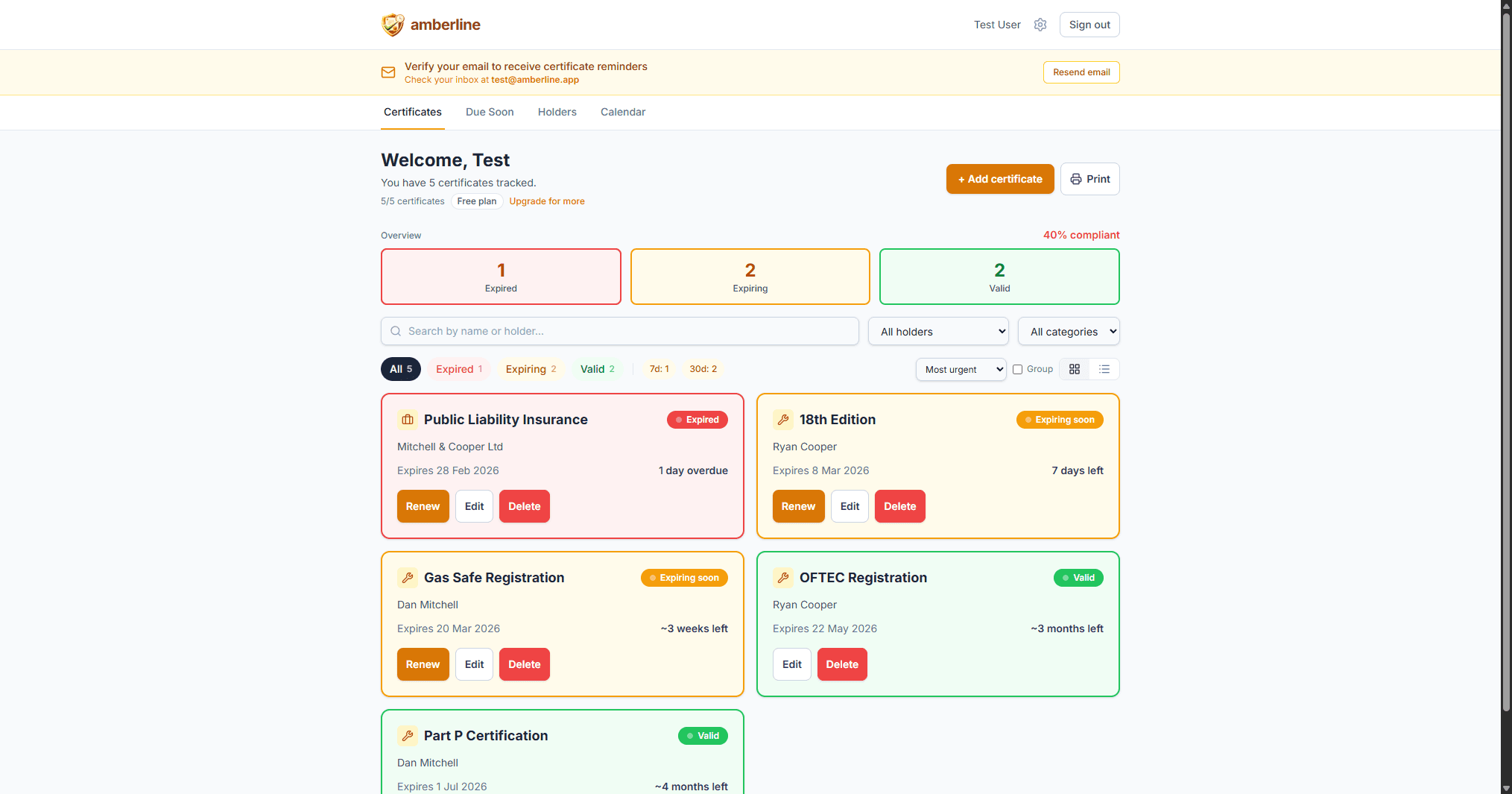
Amberline puts all four in one dashboard with a single set of reminders. Add each certificate, set its expiry date, and get automatic email alerts at 90, 30, 7, and 0 days.

No more relying on post that might get lost or emails that end up in spam.
The cost of letting a certificate lapse
For tradespeople, an expired certificate doesn't just mean a fine — it means lost income. Every day you can't work because your registration has lapsed is a day without earnings.
Factor in the cost of emergency renewal (expedited processing, re-assessment fees, rushed course bookings) and a lapsed certificate can easily cost more than the annual renewal itself.
A simple tracking system that sends reminders before certificates expire is the cheapest insurance you can buy.
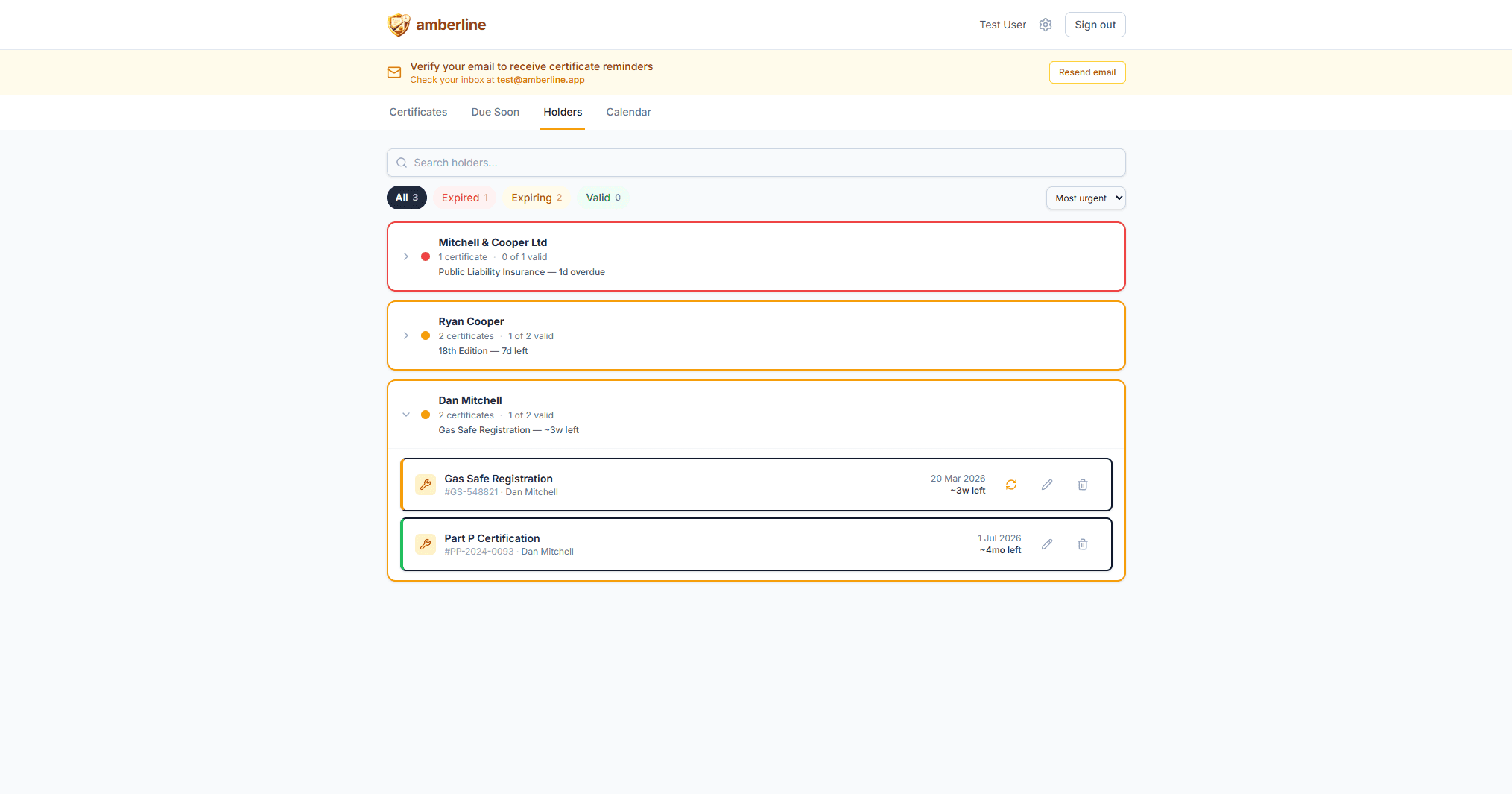
See how Amberline works for trade businesses at amberline.app/trades.
Ready to stop tracking certificates in spreadsheets?
Start free with up to 3 certificates. No card required.
Get started free