 amberline
Construction Site Compliance: Tracking CSCS, IPAF, PASMA, and More
Construction is one of the most certificate-heavy industries in the UK. A single operative can hold 4 or more cards and qualifications, each with its own renewal cycle. Multiply that across a team and you're looking at dozens — sometimes hundreds — of expiry dates to track.
Miss one, and someone gets turned away at the gate. Miss several, and your whole programme slips.
The certificates every construction firm tracks
Here's the full list of certificates that most construction teams need to manage, along with their renewal cycles:
CSCS Card
- Renewal: Every 2 years for labourer (green) cards (changed from 5 years in February 2025)
- Renewal: Every 5 years for skilled worker and other card types
The CSCS card is the most universal construction certificate — virtually every site requires one for access. The recent reduction to 2-year renewals for labourer cards means 500,000 workers now need to renew more than twice as often.
If you manage a team with a mix of labourer and skilled worker cards, you're now tracking two different renewal cycles for the same type of certificate.
IPAF Licence (Powered Access)
- Renewal: Every 5 years
- Required for: Operating mobile elevating work platforms (MEWPs) — cherry pickers, scissor lifts, boom lifts
An expired IPAF licence means the operative cannot legally use powered access equipment on site. If they're a specialist operator, that's a direct hit to your programme.
PASMA (Mobile Access Towers)
- Renewal: Every 5 years
- Required for: Erecting, altering, and dismantling mobile access towers (scaffold towers)
Similar to IPAF — without a valid PASMA certificate, the operative can't work with tower scaffolds. This catches firms out because the 5-year cycle means renewals are easy to forget completely.
CPCS Card (Plant Operations)
- Renewal: Every 5 years (with a 2-year technical test)
- Required for: Operating plant machinery — excavators, telehandlers, cranes, dumpers
CPCS is more complex than other cards because it has a two-stage renewal: a technical test at 2 years and a full renewal at 5. Miss the technical test and the card is suspended.
First Aid at Work
- Renewal: Every 3 years
- Required by law: At least one qualified first-aider per site (exact numbers depend on site size and risk assessment)
An expired first aid certificate can invalidate your site's HSE compliance. It's also one of the certificates that insurers check.
Manual Handling
- Renewal: Every 3 years (recommended — no fixed legal requirement)
- Who needs it: Anyone lifting, carrying, or moving loads as part of their work
While there's no hard legal expiry, most principal contractors require current manual handling training as a condition of site access. Best practice is to treat it as a 3-year renewal.
Asbestos Awareness
- Renewal: Every 12 months
- Required by law: All workers who might disturb asbestos during their work
Annual renewal makes this one of the most frequently expiring certificates on the list. It's easy to lose track of when each operative last completed their awareness training.
SMSTS / SSSTS (Site Management Safety Training)
- Renewal: Every 5 years
- SMSTS: Site Management Safety Training Scheme (for site managers)
- SSSTS: Site Supervisors Safety Training Scheme (for supervisors)
These are management-level qualifications. Fewer people hold them, but they're critical — a site manager without a valid SMSTS can't fulfil their safety responsibilities.
DBS Check
- Renewal: No fixed expiry, but many contractors require checks within the last 3 years
- Required for: Work near schools, hospitals, or other sensitive sites
DBS checks are increasingly required on construction sites near vulnerable populations. Like nursery DBS checks, the lack of a printed expiry date means you have to set your own renewal schedule.
The maths of construction compliance
Here's where it gets real. Take a modest team of 20 operatives. If each person holds an average of 4 certificates, you're tracking 80 expiry dates.
Now consider the renewal cycles:
- CSCS labourer cards: every 2 years
- Asbestos awareness: every 12 months
- First Aid: every 3 years
- IPAF / PASMA / CPCS: every 5 years
These cycles don't align. In any given month, you'll have certificates expiring across different people and different types. There's no "one renewal date" to remember — it's a constant, rolling process.
At 80 certificates, a spreadsheet doesn't cut it. You need automatic reminders that chase you before each certificate expires, without you having to manually check dates.
Setting up construction certificate tracking
Amberline includes pre-loaded templates for every construction certificate listed above. Adding a certificate takes about 15 seconds: pick the template, enter the operative's name, set the expiry date.
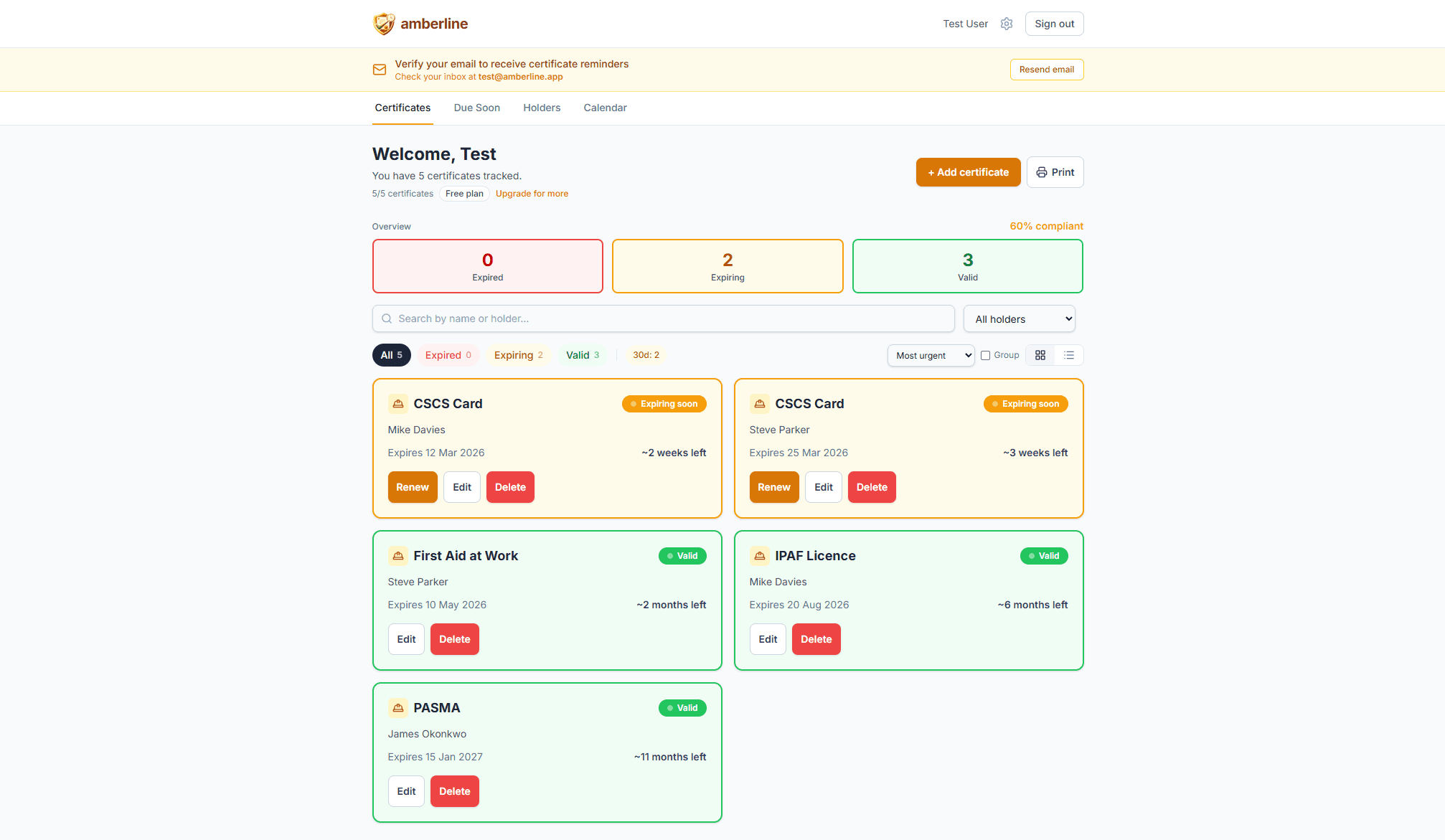
For a team of 20, initial setup takes about 30 minutes. After that, the system handles the reminders — 90, 30, 7, and 0 days before each expiry.
Tracking by operative
The most useful view for construction firms is by person. You want to see "which of my team has everything current?" not "which CSCS cards are expiring?"
The Holders view shows each operative as a card with their worst-status certificate highlighted. If everyone is green, you're good. If someone is amber or red, you can see exactly which certificate needs attention.
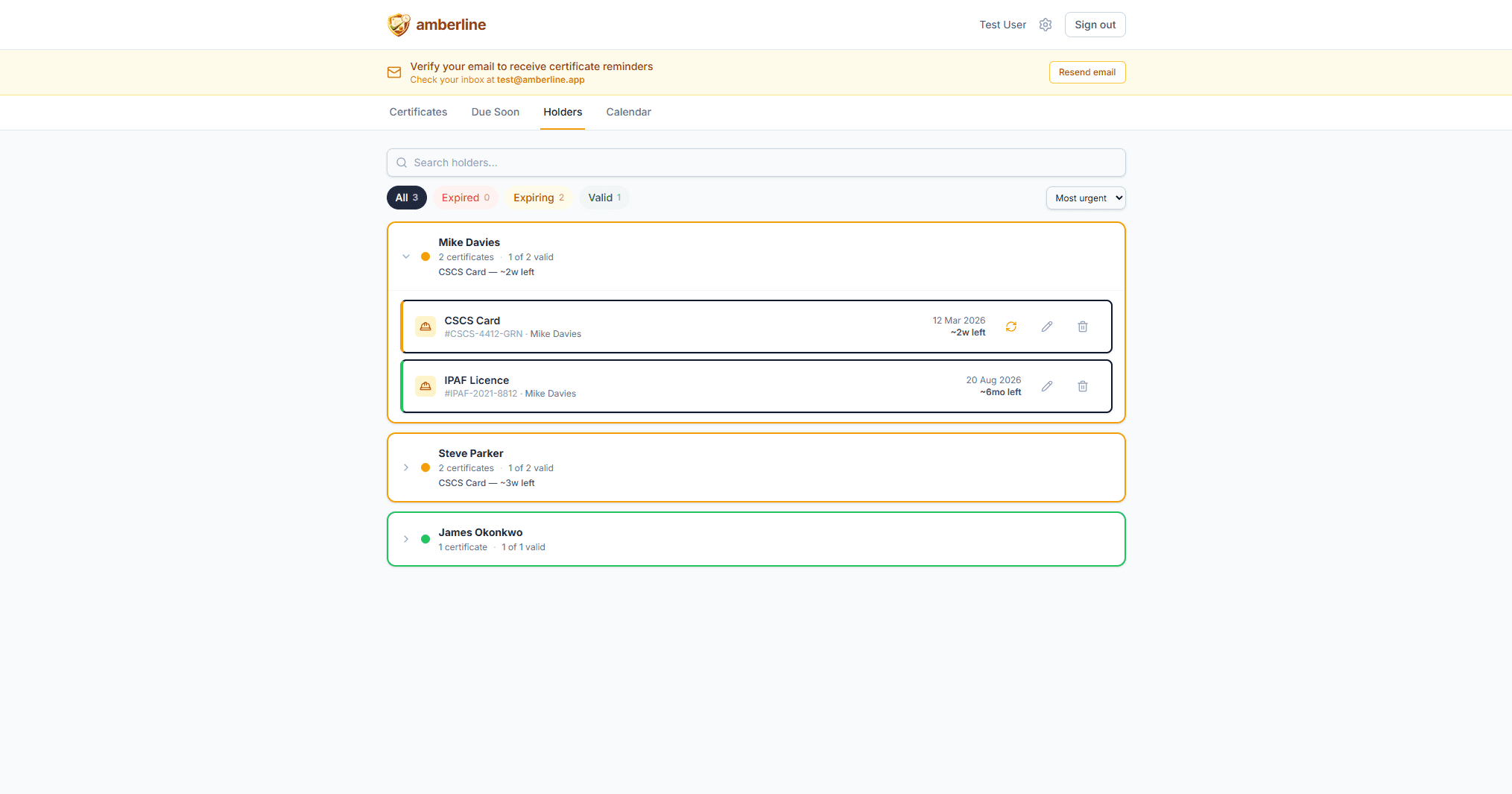
This view is particularly valuable before site mobilisation. Pull it up, scan for any amber or red, and you know immediately whether everyone can access site on day one.
Planning renewals with the calendar
Some renewals need advance planning. SMSTS is a 5-day course. CSCS renewal requires booking an NVQ assessment or completing the HS&E test. First Aid is a 3-day course.
The calendar view shows expiry dates plotted by month, so you can see what's coming up and batch renewal bookings together.
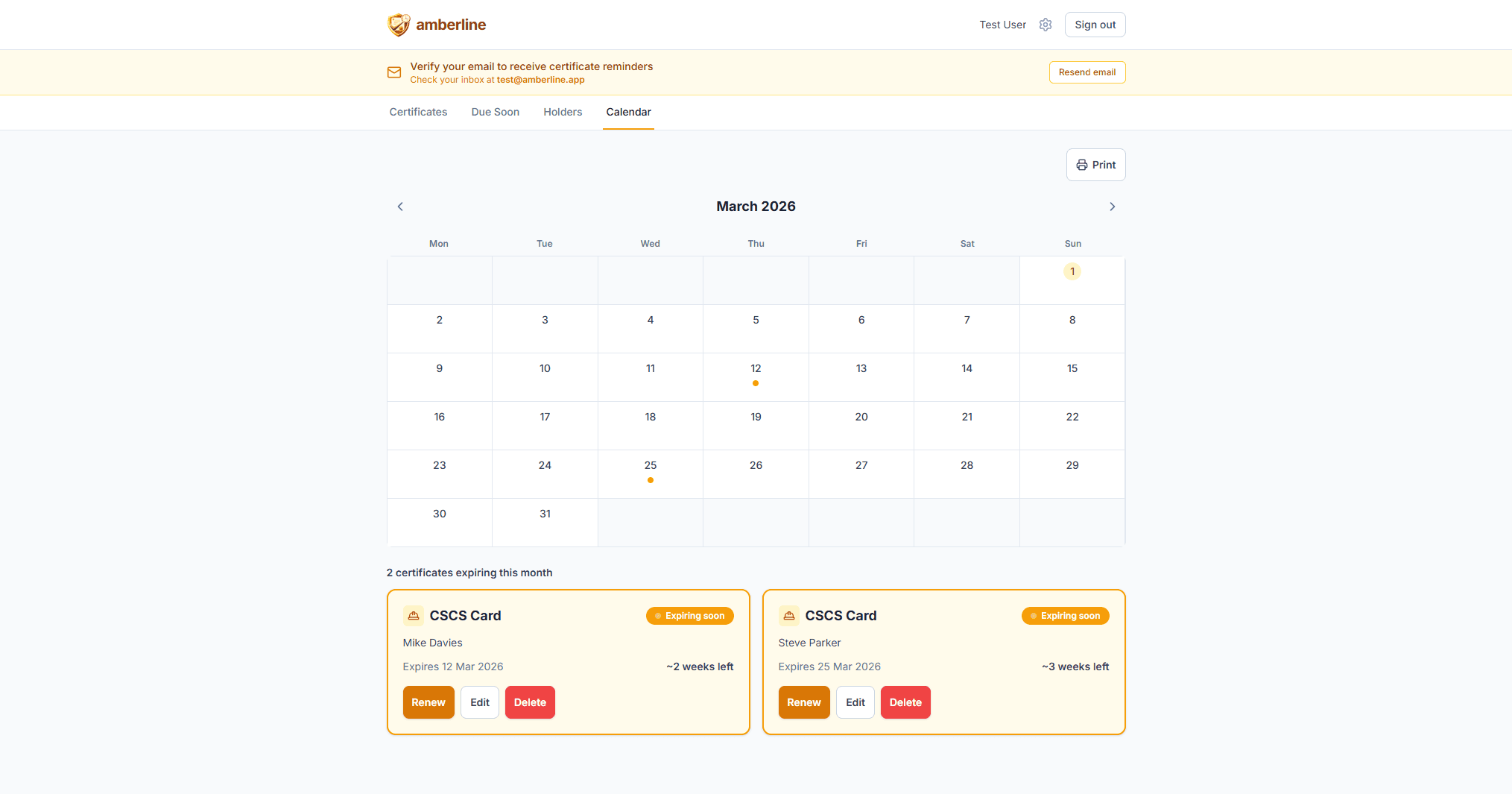
Batching makes sense economically too — training providers often offer group discounts for 5+ delegates on the same course.
The real cost of expired certificates
When an operative turns up to site with an expired CSCS card, the consequences cascade:
- They can't access site. Gate security checks cards. No valid card = no entry.
- You're short on labour. The programme takes a hit while you find a replacement or fast-track a renewal.
- Emergency renewals cost more. Expedited processing, rush-booked courses, and last-minute cover all cost more than planned renewals.
- It reflects on your company. Principal contractors track subcontractor compliance. Multiple lapses can affect your ability to win future work.
Prevention is always cheaper. A 90-day reminder costs nothing and gives you enough time to book a course, schedule an assessment, and renew the certificate before it becomes a site-access problem.
One dashboard for the whole team
Amberline is built for exactly this scenario — tracking multiple certificates across multiple people, with automatic reminders that handle the chasing.
Free for up to 3 certificates. The Pro plan covers unlimited certificates for firms with larger teams.
See how it works for construction at amberline.app/construction.
Ready to stop tracking certificates in spreadsheets?
Start free with up to 3 certificates. No card required.
Get started free